

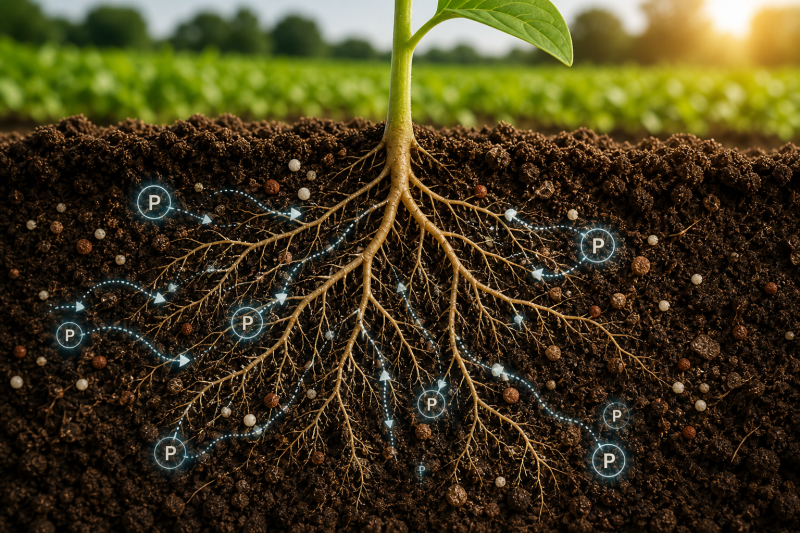
Phosphorus Management: Why the Root Zone Matters
Phosphorus is one of the major nutrients required for healthy crop development.
It plays an important role in root establishment, energy transfer, early plant growth and reproductive development. However, phosphorus behaves differently from many other nutrients in the soil.
Unlike highly mobile nutrients, phosphorus generally moves only limited distances through the soil. This means that successful phosphorus management depends heavily on where phosphorus is located, how available it is and how effectively roots can reach it.
For this reason, the root zone should be at the centre of any phosphorus-management strategy.
1. Why Phosphorus Is Important for Crops
Phosphorus participates in several essential plant processes.
Adequate phosphorus nutrition is commonly associated with:
- Root development
- Early crop establishment
- Energy transfer within plant cells
- Flowering and reproductive development
- Overall plant growth
- Efficient crop development
Phosphorus is particularly important during the early stages of crop growth, when a developing root system needs access to sufficient nutrients.
However, simply having phosphorus present in the soil does not necessarily mean that the crop can access it efficiently.
2. Why Phosphorus Availability Can Be Challenging
Phosphorus can react with different components of the soil.
Its availability may be influenced by:
- Soil pH
- Soil mineral composition
- Organic matter
- Moisture
- Temperature
- Root activity
- Microbial activity
- Previous fertiliser applications
- Placement of phosphorus inputs
Under certain soil conditions, phosphorus can become associated with compounds that make it less readily available to plant roots.
This is why soil testing and understanding the local soil environment are important before deciding how phosphorus should be managed.
3. The Root Zone Is Where Nutrient Access Happens
Plants absorb phosphorus mainly through their roots.
Because phosphorus does not move freely through soil, roots must grow close enough to available phosphorus sources to absorb them effectively.
A healthier and more extensive root system can explore a larger volume of soil, increasing the possibility of accessing phosphorus and other nutrients.
This means phosphorus management should not be separated from root-development management.
Improving soil conditions around roots can therefore be just as important as selecting the nutrient source itself.
4. Soil Structure Influences Root Exploration
Roots need a suitable physical environment to grow through soil.
Compaction, poor aeration or weak soil structure can restrict root development and reduce the volume of soil that roots are able to explore.
On the other hand, improved soil structure may allow roots to:
- Penetrate deeper
- Develop more lateral roots
- Explore a larger soil volume
- Access moisture more effectively
- Interact with a larger nutrient pool
This is one reason organic-matter management and phosphorus nutrition are closely connected within a broader soil-health strategy.
5. Organic Matter Can Support the Root-Zone Environment
Organic matter contributes to the physical and biological condition of agricultural soils.
It can help support:
- Soil aggregation
- Moisture management
- Biological activity
- Nutrient cycling
- Root-zone development
A healthier root-zone environment can improve the overall conditions in which phosphorus and other nutrients interact with plant roots.
Organic nutrient inputs should therefore be viewed as part of an integrated soil-management programme rather than only as sources of individual nutrients.
6. The Role of Phosphate Rich Organic Manure (PROM)
Phosphate Rich Organic Manure, or PROM, is an organic phosphorus-focused input used in agricultural nutrient-management programmes.
PROM is generally positioned to combine a phosphorus source with organic material, allowing phosphorus management to be integrated with broader soil-health objectives.
Depending on product specification and soil conditions, PROM may be considered as part of programmes designed to support:
- Phosphorus nutrition
- Root establishment
- Soil organic matter
- Integrated nutrient management
- Biological soil activity
PROM should not be treated as a universal replacement for all phosphorus fertilisers.
Its suitability depends on factors such as soil-test results, crop requirements, nutrient analysis and local agronomic recommendations.
7. Soil pH Has a Major Influence
Soil pH plays an important role in phosphorus behaviour.
When soil conditions move significantly outside favourable ranges, phosphorus availability can become restricted through different chemical reactions.
This is why growers should avoid making phosphorus decisions only on the basis of crop symptoms.
A soil analysis can provide useful information about:
- Soil pH
- Available phosphorus
- Organic matter
- Other major nutrients
- Soil fertility status
These results can then be used to design a more targeted nutrient-management programme.
8. Soil Biology Also Matters
The root zone contains a complex biological community.
Microorganisms participate in processes that influence the transformation and cycling of nutrients in soil.
Certain beneficial biological inputs are used to support nutrient mobilisation or improve the biological environment around plant roots.
For example, mycorrhizal fungi can form associations with roots and extend the effective area through which plants interact with surrounding soil.
Such biological approaches should be integrated with proper agronomy rather than used as substitutes for balanced crop nutrition.
9. Placement and Timing Can Affect Efficiency
Because phosphorus is relatively immobile, its placement can influence how effectively developing roots reach it.
Depending on the crop and production system, phosphorus inputs may be incorporated during:
- Land preparation
- Basal nutrient application
- Pre-sowing programmes
- Planting or transplanting
- Orchard or plantation establishment
The correct approach will depend on the crop, soil condition, nutrient source and local recommendations.
Applying more phosphorus is not always the most efficient solution.
The objective should be to create the right combination of availability, placement and root access.
10. Start With Soil Testing
Responsible phosphorus management begins by understanding what is already present in the soil.
Growers should ideally evaluate:
- Current phosphorus status
- Soil pH
- Organic matter
- Crop nutrient requirement
- Previous nutrient applications
- Expected crop yield
- Irrigation and moisture conditions
This information can help avoid unnecessary applications and improve the efficiency of phosphorus programmes.
A Better Approach to Phosphorus Management
Phosphorus management is not simply a question of selecting a fertiliser and applying a fixed quantity.
It involves understanding the relationship between:
soil chemistry + organic matter + biology + roots + crop nutrition
When these elements are managed together, growers can create a more favourable environment for nutrient access and crop development.
At GAONKALA AGRO, we believe nutrient management should begin with the soil and root zone.
The objective is not simply to add more nutrients, but to build soil systems in which roots can interact with nutrients more efficiently and responsibly over time.








.png)